Technology can help, but it cannot replace trust
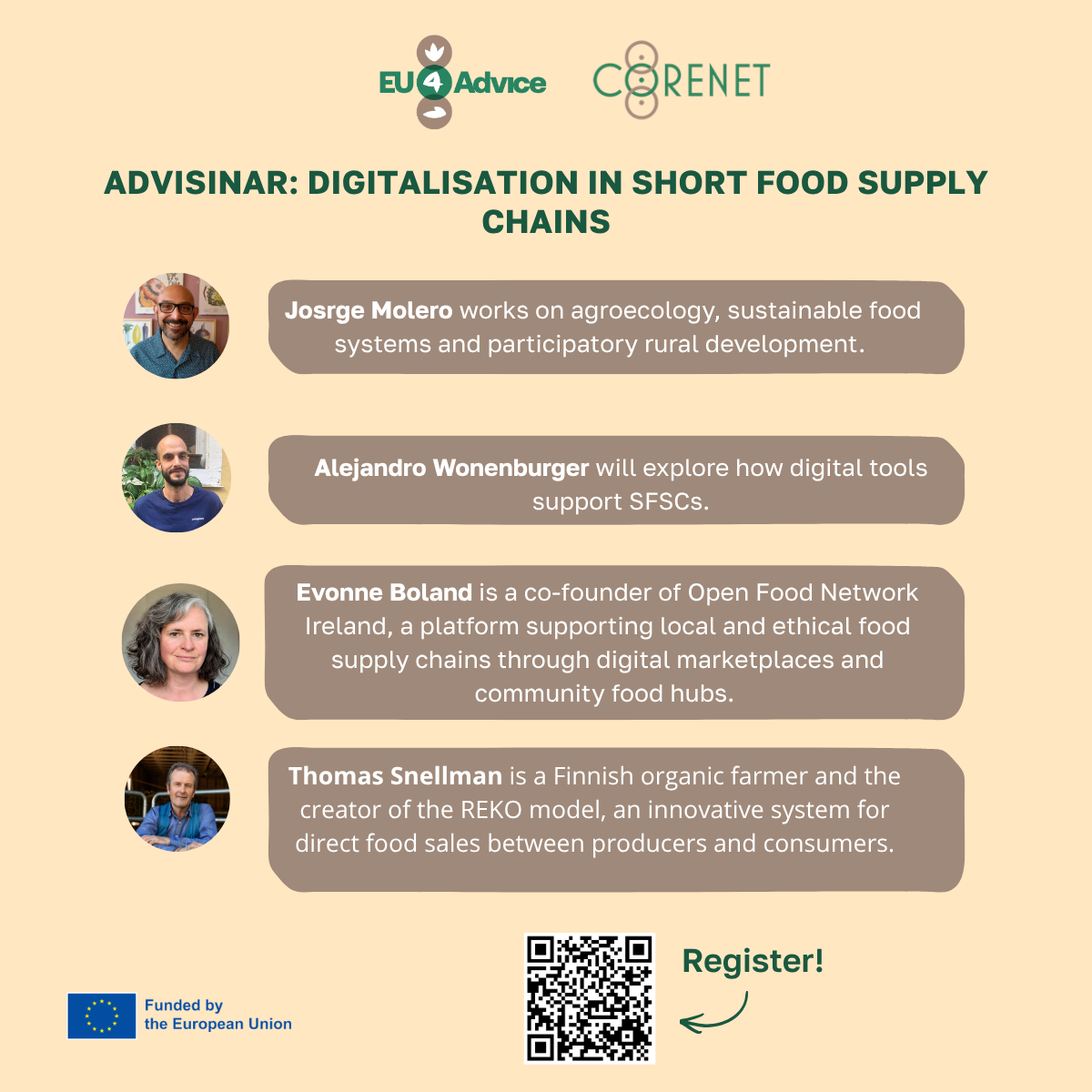
On the 18th of May, four practitioners from all over Europe gathered to share their learnings on the use of digital tools in short food supply chains. The message was simple: The tool is not the beginning.
For most small food businesses, there’s a time when someone says “Let’s go digital. Perhaps you get the orders in by email, via WhatsApp and phone at the same time. Perhaps a farmer is spending too much time on paperwork rather than out in the field. Grasping a tool is a natural tendency. As was demonstrated by the speakers at the Advisinar, the important point is what is done before that moment.
Over 70 advisors, farmers and food system practitioners participated in the session online to hear from four speakers who have very different experiences of the digitalisation of short food supply chains.
Jorge Molero began the session with a framework that he has been developing over the years related to food cooperatives and short supply chains. The essence of his argument was that digitisation is only possible if everything else around it is stable.
A short food chain isn’t simply about getting food from a farm to a table, he said. It is a movement of funds, information and orders at the same time and sometimes in both directions as well. It is important to have a well-defined strategy, working business model, and an operational process that is both designed and understood by the producer or cooperative before a digital tool can be of benefit. Technology will make an impact only then.
An automated mess is produced by automating a mess. Technology is an extension of the best and/or worst.
Jorge also explained three tensions that are prone to arise when short food supply chains go digital. It isn’t possible to replace meeting a farmer with a photo of a vegetable. No star rating system can substitute for a genuine relationship. The more seamless a digital transaction gets, the more it is easy to forget the story of the food. This isn’t an excuse to not use digital tools, he said. They are to be used with caution.
Alejandro Wonenburger shared his team’s eight-year journey to create a platform called Plant on Demand that they’ve been developing closely with dairy farmers, vegetable growers, cheese producers, food hubs, and cooperatives that would use it.
The platform is a single place for order management, product catalogues, customer communications, invoicing and traceability. One of the issues it was meant to address is the issue of receiving orders simultaneously from several channels. The platform lets a producer create their own online store, establish their delivery terms and payment options, and allow customers to order within these parameters, which reduces the number of questions they need to answer about logistical issues and increases the time in the field.
Jorge Molero began the session with a framework he has developed over many years working with food cooperatives and short supply chain, highlighting what matters: “It’s not about the tool per se, it’s about how it is used. His team invests a lot of effort into the onboarding and support of producers as a transition process; if people aren’t ready and supported, the tool doesn’t work.
It is now being used in Spanish, Basque, Catalan and Galician by some 300 producers directly and some 500-600 more via food hubs. Plans begin at €30/month.
The Open Food Network is a network that began in Australia in 2012 and now works in approximately 15 to 20 countries, supporting some 2,500 community food enterprises, introduced by Evonne Boland.
It is different in that it is not a model of ownership and governance. The software is free and available under open source license. They are each represented by a local self-hosted instance, with a local team leading the way, and influenced by the needs of the producers and hubs operating the instance. The users’ feedback goes back to the central development team, new features are developed and distributed to each instance, and the price is kept as low as possible since the organizations running each instance are not-for-profit.
For Evonne, the experience in Ireland, where she co-founded the Irish instance in 2020, has also been a reminder of this: The system needs to be ready, as Jorge said. Irish SFS chains remain very young and the absence of a digital tool, even if it is good, does not overcome the underlying structural problems of small-scale production, processing facilities and consumer behaviours. It’s not just a digital tool that’s going to solve our problems,” she said.
OFN Ireland is available for producers and food hubs to use, and Evonne was willing to deliver another half hour demo session if producers wished to see it in detail.
Thomas Snellman finished the presentations with the experience he had had when visiting a community supported agriculture delivery in France, and seeing the possibility to reach the people he wanted to serve without the middlemen of supermarkets, which he saw as the ideal solution: a model that he had started in 2013 in Finland.
For all intents and purposes, REKO is a pre-ordered farmers market. Producers post their bid on a Facebook group. Consumers place their orders in the comments. All assemble at one time and at the same location for exchange, where 100% of the consumer’s payment is directed to the producer. No charges for using a platform, no membership scheme, no organisation behind it.
Thomas didn’t know what would happen next. There are currently REKO circles in more than 800 locations around the world and 3.5 million members. In Stavanger, Norway, 53% of the 150,000 people in the city belong to the same REKO circle. Within Thomas’s home town, 40 per cent of the local population are members of the circle, and on certain days over 3,000 members visit the Facebook page.
Five years ago I did not have any future. You have restored to me my future. A small-scale producer, following a REKO delivery.
Thomas was adamant that Facebook won’t be forever, and that eventually, it’ll need a new technical house. For the time being, though, the social aspect of the site – that is, the ability to see the dialogue between producers and consumers – is part of what makes it so successful.
Following the presentations, discussion raised the scale, sharing of data and the challenges the short food supply chain would face to reach a much larger number of people. Jorge explained some of the initial work in Spain to develop a network of food hubs throughout regions sharing products. Evonne stressed the importance of choosing digital providers whose values and approach to data you can trust. The issue is not only how to digitalise, but how to do so without losing what makes local food so special compared to what’s found in a supermarket, as one of the participants summarized it.
On 22 June, the next Advisinar will be dedicated to a very practical question for short food supply chains: slaughter and access to local meat processing.Follow EU4Advice or COREnet to keep informed.
Watch the advisinar here!
You are currently viewing a placeholder content from Default. To access the actual content, click the button below. Please note that doing so will share data with third-party providers.