Feeding Ourselves 2026 Day: Land, Food and Local Advisory Systems
26 March 2026 | Cloughjordan Ecovillage, Tipperary, Ireland
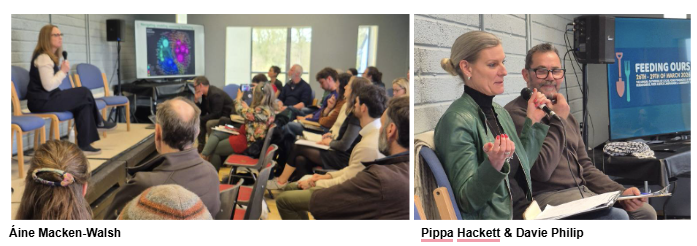
Feeding Ourselves 2026 was a four-day gathering held from the 26th to the 29th of March in Cloughjordan.
The day opened with welcome and framing from Davie Philip, Cultivate / EU4Advice, and Oliver Moore, Cultivate / CODECS. The opening panel chaired by Ruth Hegarty, Food Policy Ireland, included Fintan Kelly, Environmental Pillar; Leo McGrane, CAP Network Ireland / ERINN Innovation; Thomas O’Connor, Manna Organic Farm / Talamh Beo; and Sarah Prosser, Bioregioning South East Ireland.
Among the participants, there were food producers, researchers, advisors, policymakers and advocates from around Ireland who came together to discuss two related priorities: the creation of Land Observatories and the enhancement of advisory systems in relation to Short Food Supply Chains (SFSCs).
Policy Context
It began by identifying local food and land use within the existing Irish and European policy environment. The EU Nature Restoration Regulation is transforming the commitments of Member States, needing restoration of ecosystems and biodiversity, and to facilitate sustainable agricultural activities and environmental sound rural communities. Simultaneously, Ireland is losing vegetable producers who grow to supply local markets, underscoring the urgency of promoting local food systems, decreasing reliance on weak supply chains, and preserving value in local communities.
EU4Advice and COREnet
One of the most powerful strands in the programme was the input of the Horizon Europe projects EU4Advice and COREnet in the development of SFSC advisory systems in Ireland and Europe. Cultivate coordinated EU4Advice in Ireland, which launched the Local Food Canvas as an effective resource to assist informal SFSC advisors and Local Food Facilitators. Through joint working groups, involvement in policies, training and peer learning, the two projects are collaborating to establish a network of SFSC advisors in Europe.
Workshop 1 – Advice to Short Food Supply Chains.
The workshop discussed advisory needs of SFSCs in particular, and highlighted that effective support does not just rely on technical advice but also knowledge brokering, building relationships, coordinating networks, and building capacity. The European experience in Belgium, the Netherlands, Sardinia and Hungary illustrated the use of specialised advisors and informal facilitators to assist producers in production, processing, branding, governance and logistics.
Respondents cited major obstacles to more effective SFSC advisory systems, such as disjointed information, policy and quality assurance, poor infrastructure, and the lack of public awareness of local food as a civic good. The facilitating factors comprised tighter public procurement, flexible financing, coordination of producers, expert facilitation and relationship-building.
The workshop established that SFSC advisory is a unique area that needs recognition, training and policy support and that it is essential to integrate it into the national Agricultural Knowledge and Innovation System (AKIS).
Workshop 2 -Land Use Coordination and Land Observatories.
The second workshop addressed the necessity of increased transparency and coordination of land use in Ireland. The respondents cited lack of transparent, trusted and publicly-available information on land ownership and land-use change as one of the biggest impediments to equitable decision-making. It suggested a multi-stakeholder tool, a Land Observatory, to ensure that land is not consolidated too much, help with models of family farms, and help protect biodiversity and inform the government better.
The examples of France (SAFER), Scotland and the UK were used as international examples which are useful. It was widely agreed that the best place to start was with pilot areas and that it was a learning by doing process.
Key Takeaways
This event established that much of the building blocks of stronger local food economies and more aligned land use are already present in Ireland, but are scattered and under-supported. The two discussions identified the same basic needs, which include: more visibility, better coordination, hybrid roles like Local Food Facilitators and brokers, and a more consistent public structure to bridge practice, research and policy.
In the case of EU4Advice and COREnet, this day presented more solid evidence that SFSC advisory is a required and separate discipline, and that the Feeding Ourselves Community of Practice is a national co-designing, peer-learning and stakeholder-engaging space.
Read more at the COREnet website!