Feeding the World, How Nita van Dam is Growing a Healthier and More Sustainable Food System with Nimble
As part of the International Women’s Campaign, we will feature women working on Short Food Supply Chains who are making a difference.
In a world where convenience is sacrificed to quality and ethical standards, Nita van Dam is slowly transforming how we perceive fresh food. She is not selling vegetables alone though as a part of her business Nimble she is building a vision of a food system that stands by farmers, strengthens communities, and respects the land that sustains our lives.
What is Nimble? Current Business Status
“Business has been good and busy!” Nita tells. “We have found that there has been a lot of customer interest at the start of this year.” However, behind these few words is a tale of commitment and determination to do things right.
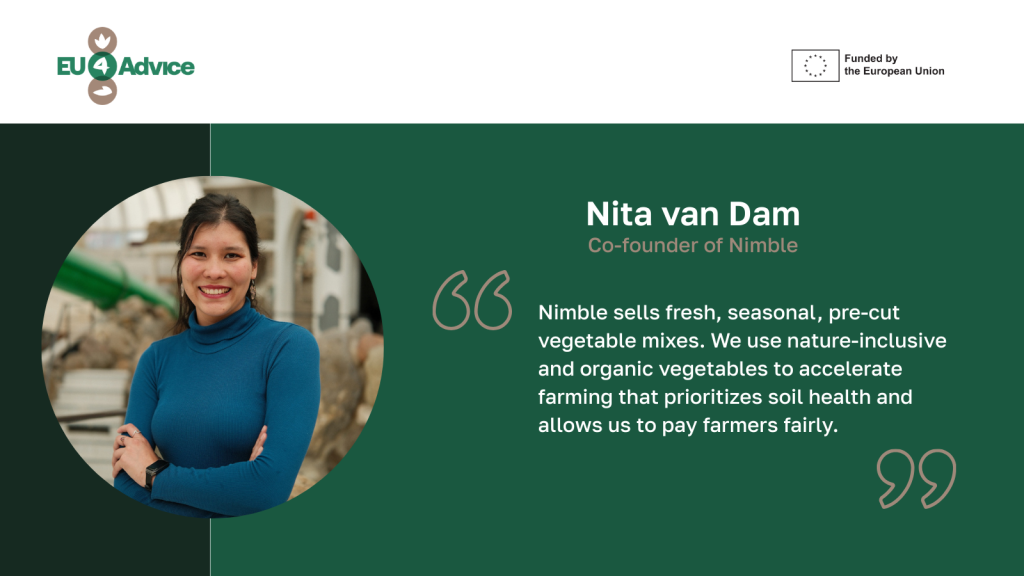
Nimble proposes a concept that is both simple and deep: fresh, seasonable, pre-cut vegetable mixes. The thing is, they make it special not just in how they sell it, but in what they sell. All vegetables are either nature-inclusive or organic. Also, all the farmers are paid fairly. Customers can be assured that the ingredients are entirely Dutch, as their origins can be traced back to Dutch roots.
Nita and her team mainly target B2B clients, i.e. catering companies, hospitals, and offices, as this enables them to increase their influence. It is not merely that they are nourishing people, it is a whole community that they feed, one institution at a time.
Biggest Challenges in the Food System
It is never easy to create something worthwhile, and Nita is not afraid to be quite open about the challenges in her path. A significant challenge, she says, is sales. We are competing with a traditional, efficient food system that is very conventional. In the Netherlands, where price competition prevails over all else, the ability to create space for value-based niche products takes an extraordinary degree of willpower. There is also the struggle to start up: to be taken seriously, when you are not the most experienced, when you do not have the track record that large customers believe in. They are not mere business problems; they are systemic problems, and everyone struggling to create a more ethical and sustainable food system has faced them.
Now here is where Nita can shine through. Once she hired a salesperson and discovered that the problem was not a lack of network or knowledge, but a rhythm of relationship-building, she and her co-founder realised they were the best people to be doing what they were doing. According to her, this is because they passionately believe in the product, which enables them to explain its significance and definition to final customers. Real care is sometimes the greatest sales weapon.
Invisible Aspects of the Work
What should be understood but is not evident in the story of Nimble is the physical effort required to get to know it. Nita observes that people do not see or comprehend the physical, manual labour of pre-cutting vegetables. Big businesses use huge machines, whereas small businesses like hers use human hands to meticulously cut lettuce, broccoli, and cauliflower. This is no drawback to manual work and this is what makes their approach more personal and closer to the food that they are working on. All of the cuts are geared to make sure that busy chefs and institutions are not denied the opportunities to provide nutritious meals without losing quality and values.
Advice for New Producers
To other people aspiring to create something worthwhile in the food system, Nita can give valuable tips based on her experience. Timing is the most important, she notes. Nimble was successful because they recognised real needs: chefs facing a workforce shortage, and farmers needing a stable scale, and solved them at the right time. However, in addition to timing, she emphasises that it must be well-researched and self-assessed. She recommends ensuring that you fit the job. Their study affirmed that there was indeed market enthusiasm in the sustainability, transparency, and products having adequate volume to sustain operation. Knowing these realities before plunging in helped them build something sustainable.
Most Important Lesson Learned
Among the deepest lessons Nita teaches is the wisdom of seeking support. She admits they realised they should seek assistance, especially in operations and food safety. Although she had a degree in food science, she acknowledged her weaknesses and consulted professionals who could help her. The best advice she received? Outsource individuals who can give you a better job than you can in certain activities, and instead concentrate on the big picture.
She says that growing the company means hiring individuals who are better than you to do the delegation and maximise your time. It is also a lesson in humility and business: you need to tend to your business, and sometimes you have to have faith in others to help you carry the burden.
When prompted to list the most important thing she has learned, Nita answers something even bigger than business strategy. What she has learned was that it is important to work on a job that adds personal value and fun to it on a daily basis.
It is an honour to do something that you love. It is the wisdom of the caregiver in a nutshell; it is not money that will bring happiness, but rather the realisation that what you are doing counts. In inventing Nimble, Nita has not only established a business, but she has made a life that matches her beliefs, a company that is concerned about farmers, customers and the planet without favouring one above the others.
Behind all the pre-cut vegetable blends is a dedication story. In any deal with a farmer, there is respect. There is the promise of nourishment, something more than physical, in any delivery to a hospital or school. Nita van Dam reminds us that it is not only the business’s bottom line that matters, but also the soul that makes it sustainable. And, maybe, that is the most significant ingredient of all.