Food Hubs are at the heart of Short Supply Chains
Three stories of connection and trust, and local food finding its way home, from the Midwest Bio District in Ireland, to a Bavarian village cooperative, and a Romanian food hub that grew out of 15 years of caring for the community.
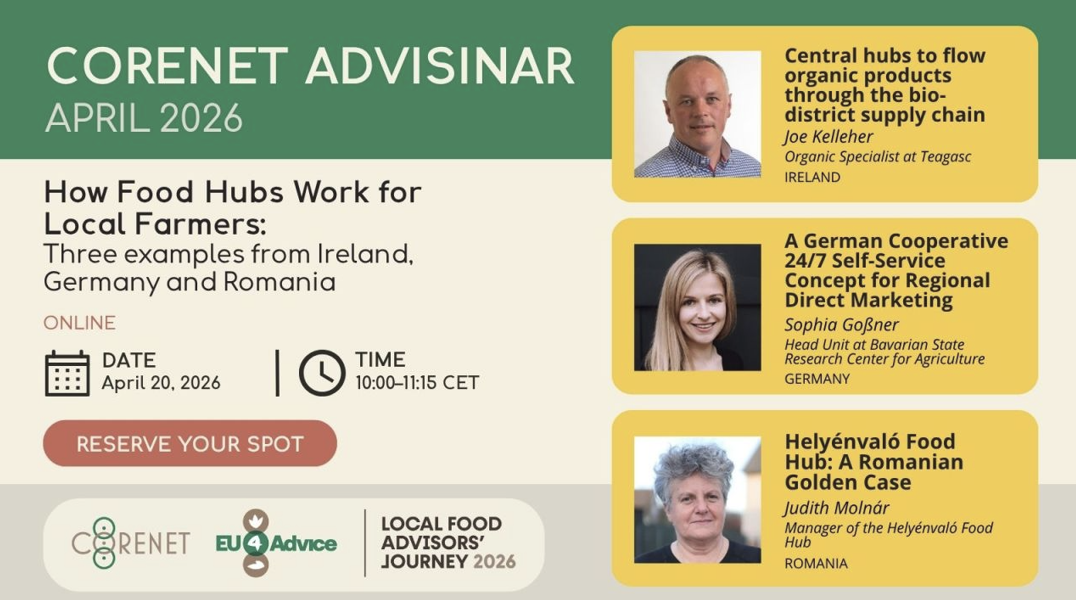
Joe Keller recognises that Ireland is unique, with 95% of farmland covered in grass, most organic farmers growing livestock rather than crops, and the closest processor on the far side of the country. As he and his team started their search for the Midwest Bio District, they realised right away that they should not start from scratch; they should look for what was happening at a more grassroots level.
They discovered a community of individuals who had already figured out how to do it themselves. A vegetable producer who has a business flair. An organic farm that is providing wholesale products to caterers and developing a processing plant. A Limerick City consumer co-operative in which the manager would sit with a new farmer before a single seed was planted and let him know straight off what the shelves needed most.
Acknowledge that not every farmer is a good marketer or salesperson It is this wisdom, this distributed network of many people doing what they’re best at, and all of them trusting the others, all of them bound by a common interest in keeping food local, that lies under every good food hub.
In Lower Bavaria, Sophia Gössner and her colleagues from the Bavarian State Research Centre for Agriculture wondered: what if there were a collective of small farms that could bear the direct marketing burden? The solution was the Klabecker Kistl: a refrigerated container located at a crossroads in the country, filled by 21 farms, operated by a local innkeeper, open every hour of every day.
It’s very basic and easy to understand. Farmers deliver their products. The innkeeper is responsible for the container. Every customer is told the name, the farm, and the story behind what they are buying, through a digital display. The system reached its break-even point at €200 of daily sales — and has been self-sustaining ever since 2024.
It is not the technology that makes it work. The care taken to avoid competition: only one supplier per product, priority given to the nearest farm and transparency in every purchase makes every handshake feel like a handshake.
The most moving story was that of Judith Molnár, who was recruited from the Hăinalu Food Hub in the Romanian short food supply chain (SFSC) landscape, located in the area of the highest concentration of SFSC initiatives in Romania, and with very little formal support for SFSC.
It took time for the Hăinalu hub to materialise. It’s 15 years of work with communities coming out of the Civitas Foundation, and it had a number of early business models that didn’t work (fresh vegetables, not refrigerated), and then it had to pivot to an online shop, which now gets three-quarters of sales, and then it reached economic sustainability in December 2025. It was 7.5 years.
Today, it has 99 producers, around 1,000 products (honeys, teas, handcrafted oils, artisan sweets, preserved vegetables, and more), and is internationally recognised as an example of community collaboration. On a live video call, Judith took the participants around the hub, where her colleague had just brought a jar of honey produced just at the door.
The same lessons in three quite different countries:
- Build on the existing. Starting again is not as strong as existing hubs, existing trust, and existing routes to market.
- Look down to the ready farmers. Don’t try to convert all of them, just support the 10–20% who are already interested in short supply chains.
- Protect the pricing. Chasing competition to yourself lowers prices. A network that is not competing with itself is always stronger.
- Be patient. Building community food systems is not a matter of months; it’s a matter of years. The journey of the Hăinalu hub is a cautionary tale, but not one unique to it. The story of Hăinalu’s hub over eight years is a cautionary tale, and it is not a singular one.
- Tell the story. People purchase local food because they connect with it, whether it’s on a digital screen within a Bavarian container or in a live video experience from a Romanian food hub.
At their best, food hubs tell a story. They’re where a farmer’s year of hard work is served at a neighbour’s table, and where both parties feel, on some level, that they belong to something they’re supposed to care about.
Get ready and don’t miss the next #Advisinar on the 18th of May! HERE!