How Real Bread Ireland has transformed isolation into a network, “Baking Is a Lonely Job”
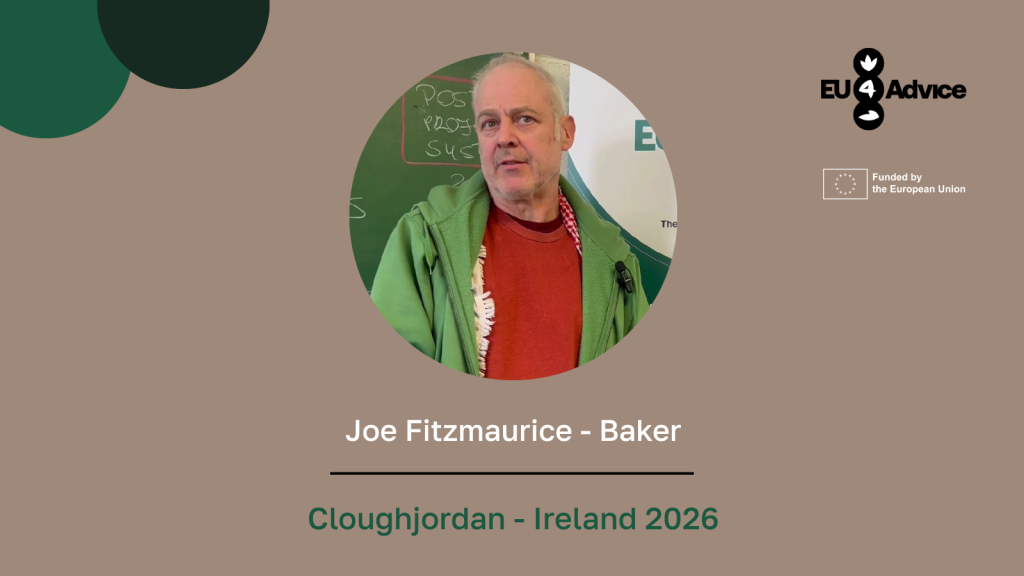
EU4Advice continues its series of testimonies and today it was the turn of the advisors, producers and network-builders who keep local food systems alive by building them from the ground up. It was a privilege to sit down with Joe Fitzmaurice from Real Bread Ireland, a network of independent bakers, millers and growers across the country, and hear what the network is about and why it is important; and how it gives an insight into the resilience of small-scale food systems.
Real Bread Ireland is not the result of a policy paper or a funding call. It was a problem of a shared nature: bread makers all over Ireland were working in isolation and not being easily accessible to other bakers, each putting in their knowledge and skills, but not having an easy way to meet and share and support each other with the everyday challenges of bread making.
From the very beginning the concept was conceived as a joint initiative between Real Bread Ireland and its sister organisation in the UK, but the idea was conceived as Real Bread Ireland as an independent organisation, based on Irish producers and conditions. It was founded by four bakers, and it was Chief Bohana who was the main organiser and kindled the flames in the early years, according to Joe.
Starting with a handful, the network has expanded to include over 250 members from every corner of the country, including bakers, millers and growers to illustrate the extent of the original need.
To Joe, Real Bread Ireland is about much more than meeting people as a network. Baking, he says, is a solitary and hard work. It takes hours, even late hours, and leaves little time and energy for producers to find other producers or to work to resolve their own issues.
The network is there, above all, to communicate: to connect isolated farmers with each other as soon as they encounter a problem. That’s very practical and everyday, and involves a vibrant WhatsApp group where people can seek assistance at any time and get a genuine response.
The types of issues discussed there are the type that would otherwise stall a small bakery: The oven motor is running on the wrong polarity, a button is hidden somewhere no one told you about so the equipment won’t reset. They are not the kind of problem that will be addressed in a manual and in a one or two man outfit they can make the difference in whether the day’s baking can be completed or not. A network of peers who’ve overcome the same issue and are happy to speak up at the drop of a hat is the key.
The network’s job is not limited to problem-solving devices. It is when things get tough that the network comes together to support its members, Joe says, citing Oak Mills in Kilkenny as an illustration. Following two years of crop failures, Real Bread Ireland has focused on securing and sustaining market linkage for the business, the practical, collective support which keeps a small producer in business when things are against them.
Another theme in the story of Joe’s is what he is not a part of: Real Bread Ireland. It deliberately eschews the food industry’s large “commodity system of extractiveness,” and the government networks he says do not foster this kind of small-scale, artisan food business.
Rather than this, the network facilitates a more direct path: food directly from producer (grower, miller or baker) to the person who will consume it. Joe is mindful that it is not the traditional “customer relationship. It’s a face-to-face exchange, a more intimate exchange, and one that is not subject to the stresses and repercussions of factory farming”.
The best thing Joe can say about the importance of small and local food chains is when a crisis occurs. Once the big snow falls and the roads get clogged, the big supermarket chains that rely on long centralised supply lines begin to falter. Shelves go empty and deliveries languish.
However, local bakeries continue to run. Food can get to individuals even if the food system can’t; bakers and customers can walk to bakery. To Joe, this is what networks such as Real Bread Ireland are all about, not as a niche or nostalgic choice that’s an alternative to the mainstream food system, but as a more resilient means of feeding a community, indeed in times of stress.
You are currently viewing a placeholder content from Default. To access the actual content, click the button below. Please note that doing so will share data with third-party providers.
This interview is part of EU4Advice’s testimonial series, which collects first-hand testimonies of advisors, producers and network builders who are working to improve and develop SFS chains in Europe. One of the grassroots projects linked to EU4Advice’s Irish Living Lab is Real Bread Ireland.