Report: SFS Innovation Platform Event on the Future of Knowledge Sharing Platforms in Europe
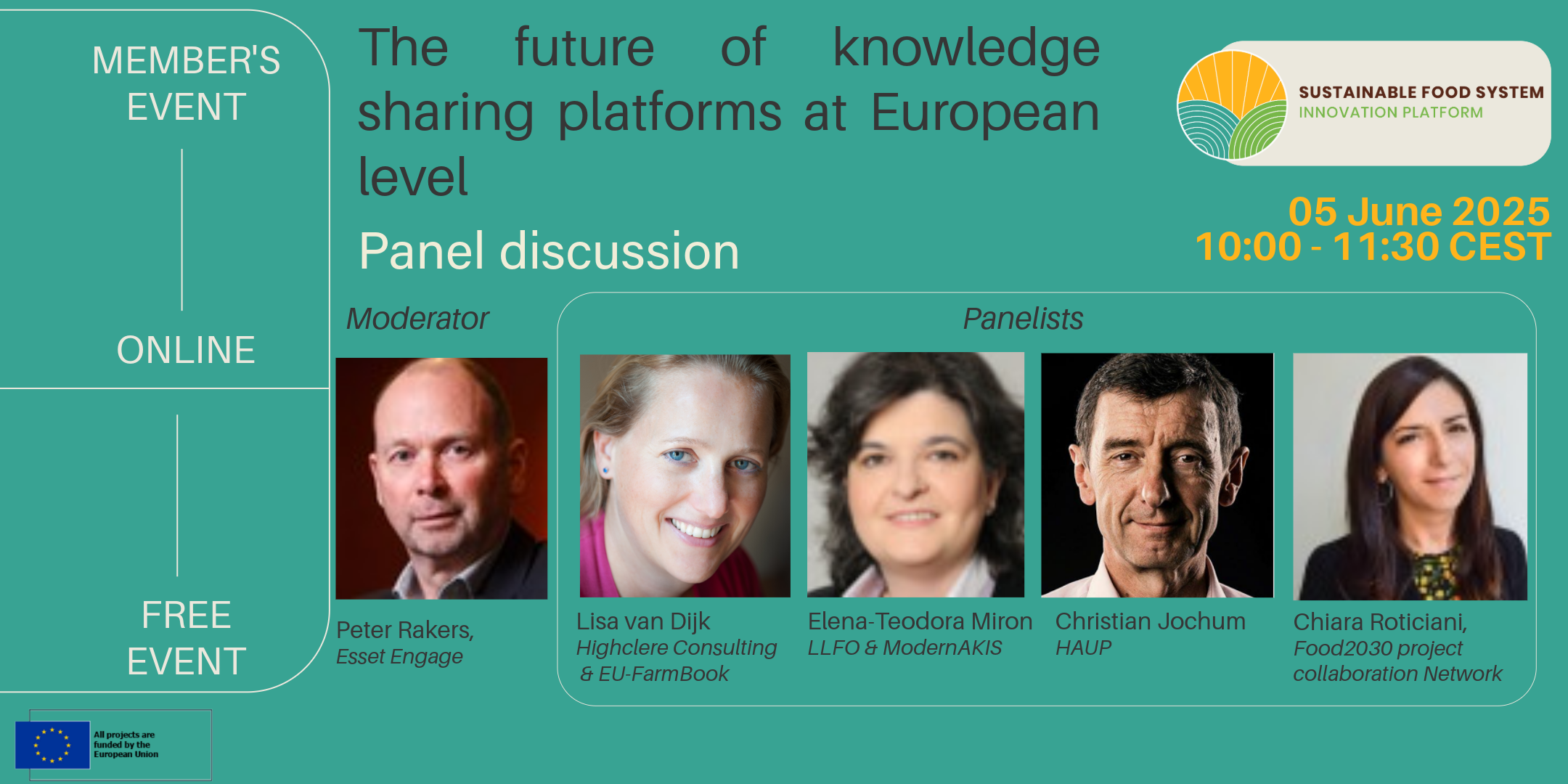
On 5 June 2025, the SFS Innovation Platform (SFSI) held an online event titled “The Future of Knowledge Sharing Platforms at European Level.” The platform, managed jointly by the EU-funded projects EU4Advice, COREnet, Watson and Wasteless, serves as a free, open-access environment designed to support collaboration among actors working across Europe’s agricultural, advisory and research landscapes. Its aim is to strengthen knowledge exchange and innovation in the transition towards more sustainable farming and food systems.
The event attracted a high level of interest, with 88 participants joining out of 123 registrants. Engagement through Slido was particularly noteworthy, with 46 individuals interacting during the session, generating an engagement rate of 91 percent . The programme opened with a welcome and an overview of the SFSI platform, introducing its structure, purpose and current functionalities. This was followed by a live Slido poll, which offered participants the opportunity to share their perceptions of the platform and highlight the features they consider most useful.
A keynote presentation by Peter Rakers from EU-FarmBook then explored how digital knowledge-sharing initiatives are evolving at European scale. His contribution helped situate the SFSI platform within a broader ecosystem of tools supporting farmers, advisors and researchers. The subsequent panel discussion brought together three experts (Lisa Williams Van Dijk (Highclere Consulting & EU-FarmBook), Elena-Teodora Miron (LFO & ModernAKIS) and Christian Jochum (HAUP)) who reflected on current challenges and opportunities for strengthening advisory networks and digital knowledge infrastructures. The discussion also highlighted ongoing efforts to increase interoperability, improve user experience and ensure more consistent support for practitioners across Europe.
Throughout the event, participants provided constructive feedback on how the SFSI platform could be improved. Many emphasised the importance of developing stronger opportunities for connection between users, as well as enhancing interactivity and alignment with other existing platforms and networks. Others stressed the need for clearer thematic filters, improved visibility of updates, easier access to new content, better overall design of inventories and stronger outreach through social media and other communication channels. Several participants also expressed interest in widening the geographical scope of the platform beyond Europe. The platform received a recommendation score of 4.1 from participants, indicating broad satisfaction alongside clear expectations for further development. Importantly, a comparison of responses before and after the group discussion showed a more aligned and coherent vision among participants regarding how the platform should evolve over the next five years, demonstrating the value of collective reflection and exchange during the event.
We can conclude that the session offered meaningful insights into how knowledge-sharing infrastructures can better support the sustainable transformation of Europe’s food systems. The contributions gathered through presentations, discussions and live feedback will inform the ongoing development of the SFSI platform and help strengthen its role as a central hub for collaboration, learning and innovation across the agri-food sector.