
School meals as a lever for local food systems: key takeaways from September Advisinar on public procurement
What children eat at school shapes far more than one lunch. It affects their long-term eating habits, the farms that supply the food, and how public money circulates in a territory. The Advisinar, “Public procurement for schools and the role of SFSCs”, organised by COREnet and EU4Advice that took place on September 21st, explored how sustainable public procurement can turn school canteens into a driver for Short Food Supply Chains. The topic was one of the most requested in our participant surveys, and 86 people joined the session.
The session opened with a European policy perspective from the Joint Research Center of the European Commission and then moved to three very different local stories from Ireland, Italy and Portugal.
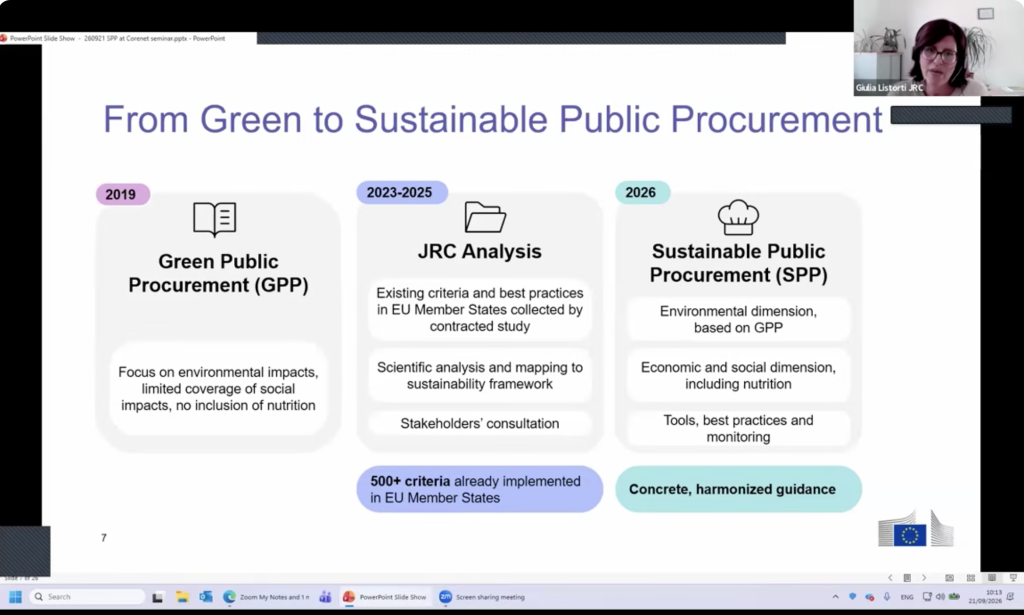
Giulia Listorti, Deputy Head of the Food Security Unit at the Joint Research Centre (JRC), and Dr Aurora Perez-Cornago, Scientific Officer at the JRC, presented the JRC’s new study on sustainable public procurement criteria for food, food services and vending machines. It builds on more than 500 criteria already used across Member States. The study goes beyond the environmental focus of the existing Green Public Procurement criteria by adding economic and social dimensions, including nutrition. Each criterion comes with ready-to-use tender text and real examples of where it is already applied. It is interesting to see that there is also a dedicated criterion on Short Food Supply Chains.
They also flagged an important development. The European Commission’s proposal for a new Public Procurement Act, released in early September, includes a dedicated article on food procurement and proposes making best price-quality ratio the norm in tenders.
Ireland: a case for community food hubs
Ruth Hegarty, CEO of Food Policy Ireland, described a very different situation. Ireland now offers free hot meals to every primary school child, but most schools have no kitchens. The programme was designed mainly as a logistics exercise, so most contracts went to a few large companies that assemble and reheat pre-cooked food in single-use packaging. The government’s own figures show about 20% of meals going uneaten.
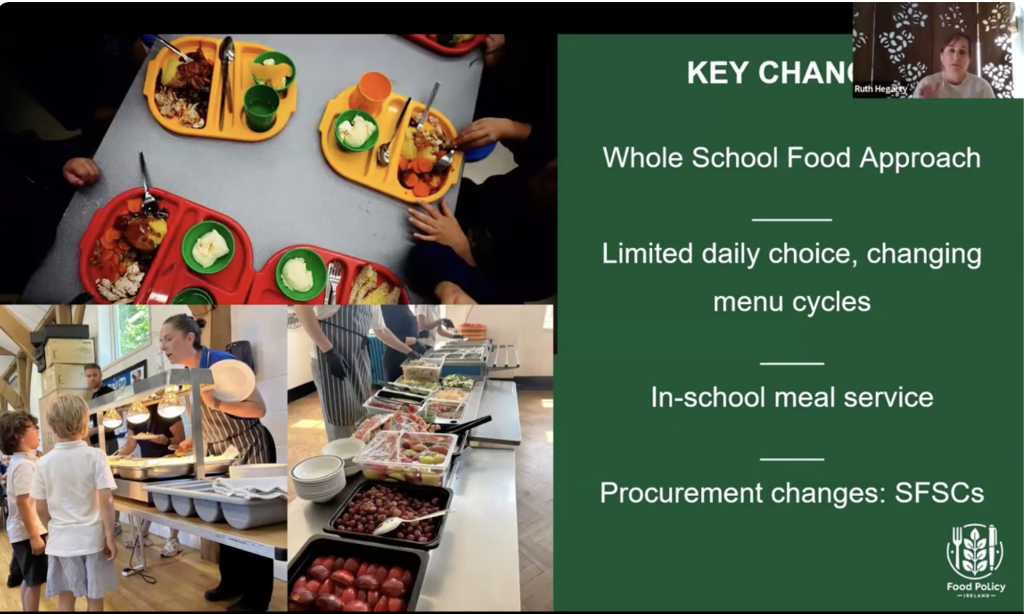
The alternative she presented is community-based. Duhallow, a not-for-profit hub kitchen in County Cork, cooks fresh meals for 30 schools within a 30 km radius. Around 75% of its sourcing is Irish and local, 88% of pupils take part in the meals, and food waste is only about 1.2%. Food Policy Ireland’s vision is a national network of 100 to 120 such hubs, supported by pilots, training and procurement guidelines that reward short supply chains.
Bergamo (Italy): starting with the tender
Nadia Tonoli, Food Policy Officer for the Municipality of Bergamo, showed how a well-designed tender (tenders are usually utilized to choose the meal providers in public schools in Italy) can become the backbone of a city’s food policy. Bergamo’s school catering contract for its 59 schools rests on five pillars:
- mandatory collaboration with the municipality on food policy
- more organic and local food
- sustainable diets with more plant protein
- food education
- food waste monitoring
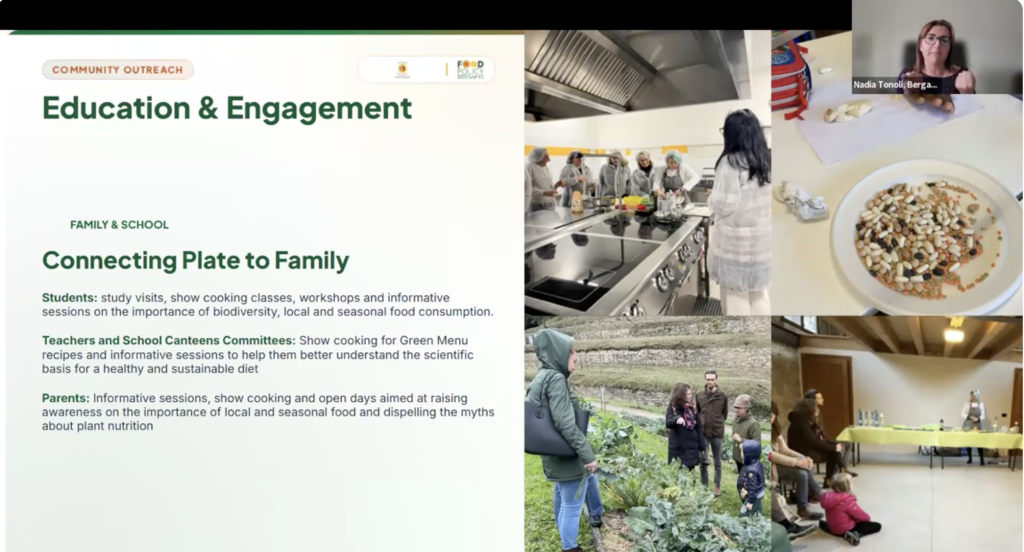
Fresh fruit and vegetables, pasta and rice are now essentially 100% organic. Part of the bread is baked in a prison social project, and a “green menu” was introduced with support from the EU project Food Trails. Her advice to other cities was simple: if you don’t know where to start your food policy, start with school procurement.
Torres Vedras: small lots, local suppliers
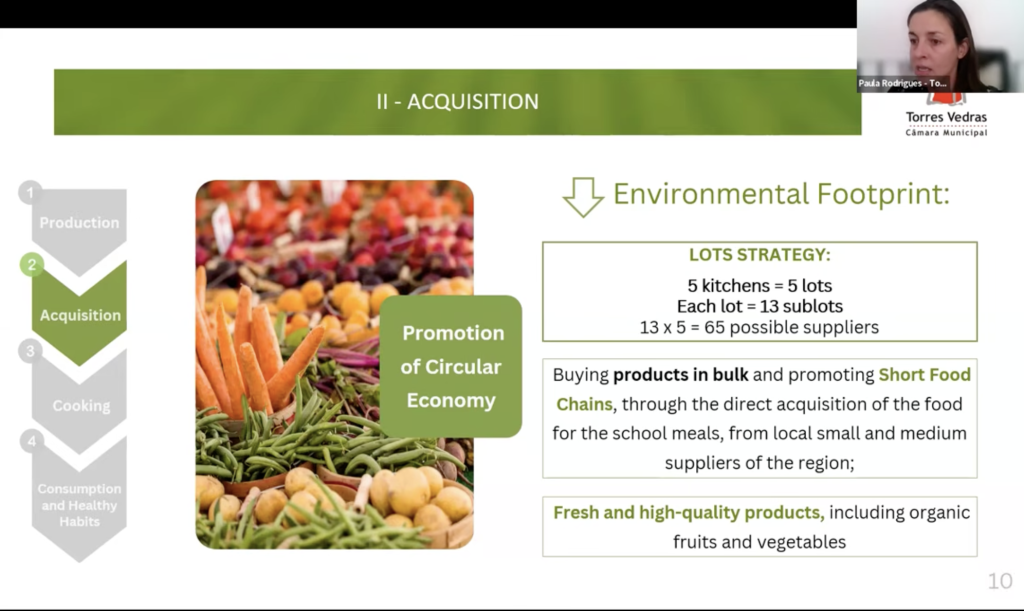
Paula Mota Rodrigues, Senior Technician at the Municipality of Torres Vedras, explained how the municipality keeps its school meals local. Its five municipal kitchens cook around 3,000 meals a day. Their procurement is split into five procedures and 13 sublots, separating organic from conventional products, so up to 65 suppliers could potentially win a contract instead of a single large company. The award criteria include food samples, freshness measured by distance to the kitchens, and the use of electric vehicles. Contracts also require bulk deliveries and farm visits for pupils.
Organic food has grown from 5% in 2019 to about 25% today, and initiatives like inviting parents to lunch on their child’s birthday bring families closer to the canteen.
Key takeaways for advisors
- Procurement is policy. All three cases showed that the criteria written into a tender decide who can supply schools and what children eat.
- Design tenders that small producers can win. Dividing contracts into smaller lots, running market dialogue before the tender, and using tools like dynamic purchasing systems or reserved contracts all help small producers take part.
- Define “short” carefully. EU rules on non-discrimination mean Short Food Supply Chains are best defined by relational proximity, meaning fewer intermediaries, rather than distance alone.
- Standards need oversight. Ruth noted that in the UK, around 78% of schools were found not to comply with existing nutritional standards. Monitoring has to be planned and funded from the start.
- Education makes it stick. Healthier, more sustainable menus work when children, parents, teachers and canteen staff are brought along.
- Advisors can be the bridge. Advisors are well placed to connect municipalities, canteen managers and farmers, especially on the recurring challenge of supplying enough volume and variety all year round.
Thank you to all the participants who joined the session and enriched the discussion with their questions and insights. See you at our next Advisinar on “Governance Models for Collective Marketing in Short Food Supply Chains” taking place online on October 19th!
In case you have missed this Advisinar, don’t worry! You can rewatch it here!